

When Your Website Visitor Is Not Human
For a long time, website owners thought about two main types of visitors: people and search engine crawlers. People read pages, compare offers, submit forms and buy products. Crawlers indexed content and helped decide how a site appeared in search results. That model still matters, but a new type of visitor is becoming increasingly important: the AI agent.
An AI agent does not browse like a person. It does not care about a beautiful hero section, it may not follow your carefully designed navigation path, and it does not always start where you expect. It comes to understand. Its job is to quickly figure out what your company does, what you sell, who your product is for, which pages contain official information and whether your website is a reliable source. That understanding can later shape an answer in ChatGPT, Perplexity, Claude or another AI assistant.
This creates a quiet but serious problem. Many websites are clear enough for humans, but messy for machine reading. Key information may be scattered across landing pages, pricing, documentation, blog posts, help articles and legal pages. A human visitor can explore, compare and make sense of it. An AI agent can try to do the same, but the more fragmented your content is, the easier it becomes for the agent to miss something important or describe your product incorrectly.
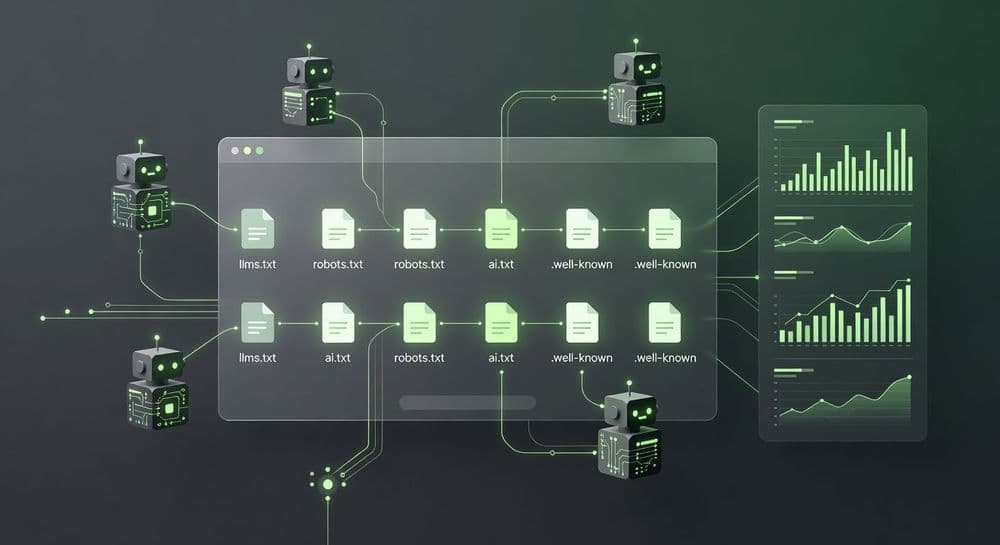
That is why machine-readable website signals are becoming part of modern web infrastructure. A clear llms.txt file, an accurate robots.txt, an updated sitemap, an ai.txt policy and well-structured /.well-known resources help agents understand where to look and what to trust. These files do not replace good content. They make good content easier to find, interpret and use.
But creating the right files is only the first step. The next question is visibility. Which AI agents are visiting your website? What pages do they read? Do they return after updates? Do they reach your documentation or only scan the homepage? Are they blocked from important sections? Are they reading the pages your team actually wants them to use? Traditional analytics tools were not built to answer these questions. They are useful for human sessions, campaigns and conversions, but AI agent behavior often stays hidden.
For marketers and founders, this blind spot is becoming more important. If AI assistants influence how people choose tools, services and vendors, then agent activity is part of the customer journey. A potential customer may never open ten websites manually. They may simply ask an AI assistant which options are worth considering. At that moment, the companies that are easier to understand have a real advantage.
well-known.io was built for this new layer of discovery. It scans websites for AI readiness, shows which files are missing or misconfigured, helps generate llms.txt and /.well-known resources, and gives businesses a better way to think about AI agent traffic. It is not about replacing SEO. It is about preparing for a world where websites are read not only by people and search engines, but also by systems that compare, summarize and recommend.
Search visibility is no longer only about ranking on a results page. It is also about how accurately AI agents understand your business, how quickly they find the right information and whether they can trust the structure of your website. Companies that prepare early will be easier to read, easier to recommend and harder to overlook when users ask AI what to choose.