

Why AI Optimization Is Becoming the Next Layer of Search
For years, companies optimized their websites for search engines. They worked on titles, metadata, structured pages, loading speed, internal links and content quality. That work is still important, but the way people discover products is changing fast. More and more decisions now start not with a traditional search page, but with an AI answer.
People ask ChatGPT, Perplexity and other AI assistants which tool to choose, which service is reliable, what company solves a specific problem or which product fits their needs. These systems do not simply show a list of links. They read, compare, summarize and often recommend. For many digital businesses, AI-generated visits and AI-assisted discovery are already becoming a visible part of traffic, sometimes reaching a meaningful share of total acquisition.
This creates a new challenge. A website may be well optimized for Google, but still difficult for AI agents to understand. Important information can be hidden across marketing pages, pricing blocks, documentation, changelogs, help centers and blog posts. A human can browse and interpret this. An AI agent can too, but it has limited time, limited context and many alternatives to compare.
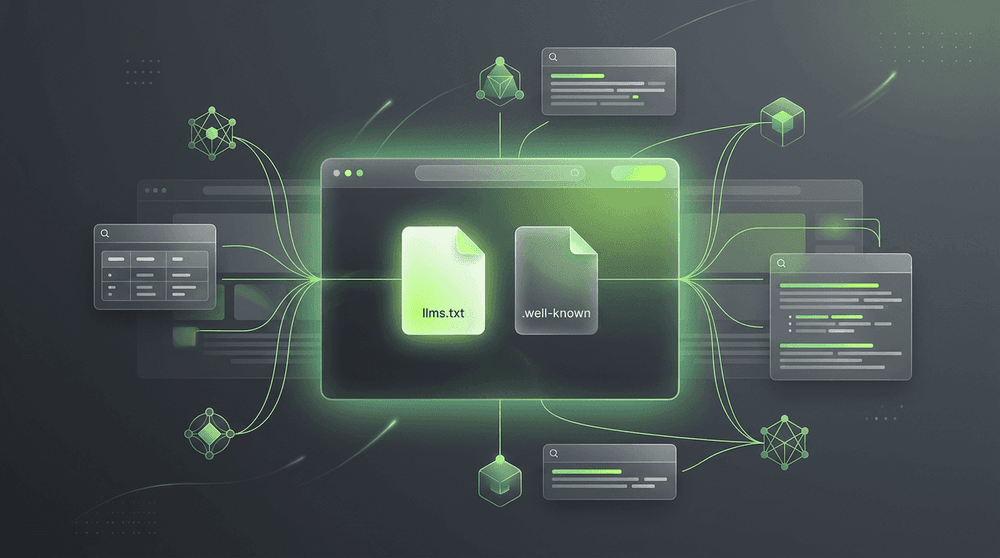
That is why AI optimization is becoming a practical layer of website infrastructure. Files such as llms.txt, .well-known resources and other machine-readable signals help AI systems understand what a company does, which pages matter, where the official information is, how to cite it and which content should be prioritized. It is not about tricking AI. It is about making the website clear, structured and easier to evaluate.
This is especially important when an AI agent needs to choose between several similar services. If one website provides clean, reliable and accessible information, while another forces the agent to guess, the first one has an advantage. Better structure means better understanding. Better understanding means a higher chance of being included in an answer, comparison or recommendation.
There is another problem that most analytics tools do not solve well. Traditional analytics platforms were built for human visitors, campaigns and conversions. They are useful, but they often do not give a clear picture of which AI agents visit the website, what they read, how often they return and which pages they use to understand the business. For marketers, founders and product teams, this is becoming a blind spot.
well-known.io was created to solve this new problem. The service scans websites from the perspective of AI readiness, helps generate the files and signals modern agents can use, and gives businesses more visibility into AI-driven activity. It helps companies understand whether their website is ready for the new discovery layer, where not only search engines, but also answer engines and autonomous agents influence demand.
SEO is not disappearing. It is expanding. The next step is AEO: answer engine optimization. Websites now need to be understandable not only to people and search crawlers, but also to AI systems that read, compare and recommend. The companies that prepare for this shift earlier will have a better chance to be discovered when customers ask AI what to choose.